Industrial Tank Coating &
Lining Services
Internal and external tank protection
We coat the inside and outside of a tank to match what each surface is exposed to, from stored product to weather.
Storage and process tanks
Lining and coating for tanks holding crude oil, fuel, water, chemicals, and process fluids.
Pressure vessels
Coating systems built around the pressure, temperature, and contents a vessel is rated for.
Corrosion protection
Barrier and inhibitive coatings that stop steel from corroding under continuous exposure to moisture, chemicals, or stored product.
Chemical resistance
Lining systems selected for the specific chemicals a tank holds, not a generic coating applied across every tank type.
Product contamination prevention
Linings that keep stored product free of contamination from the tank wall itself.
Surface preparation
Abrasive blasting and surface profiling carried out to the standard each coating system requires before application.
Application
Spray and manual application carried out to spec, with film thickness checked as work proceeds.
Inspection and QA/QC
Holiday testing, dry film thickness checks, and adhesion testing before a tank goes back into service.
Internal Tank Lining
The inside of a tank faces a different set of demands than the outside. Depending on what's stored, a lining has to hold up against corrosion, chemical attack, abrasion from moving product, and the risk of the tank wall itself contaminating what it holds. We work with epoxy, vinyl ester, and glass flake lining systems, chosen against the process fluid and service temperature of each tank.
External Tank Coating
External coatings protect a tank from what's outside it: atmospheric corrosion, environmental exposure, and weather. Above-ground tanks face different exposure than buried storage, and a tank's shell and roof often need a different coating spec from its foundation. We match the coating system to where a tank sits and what it's exposed to.
Tank Bottom Coating
Tank bottoms sit closest to moisture and are often where corrosion starts first. We coat tank bottoms against corrosion, standing moisture, chemical exposure, and the deterioration that comes with years in service.
Tank Shell & Roof Coating
Shells, roofs, external surfaces, and the steelwork attached to a tank - all need coating that holds up under continuous outdoor exposure. We coat and maintain these surfaces to keep the coating system intact across the whole structure, not just the areas most visibly weathered.
Internal Tank Lining Services
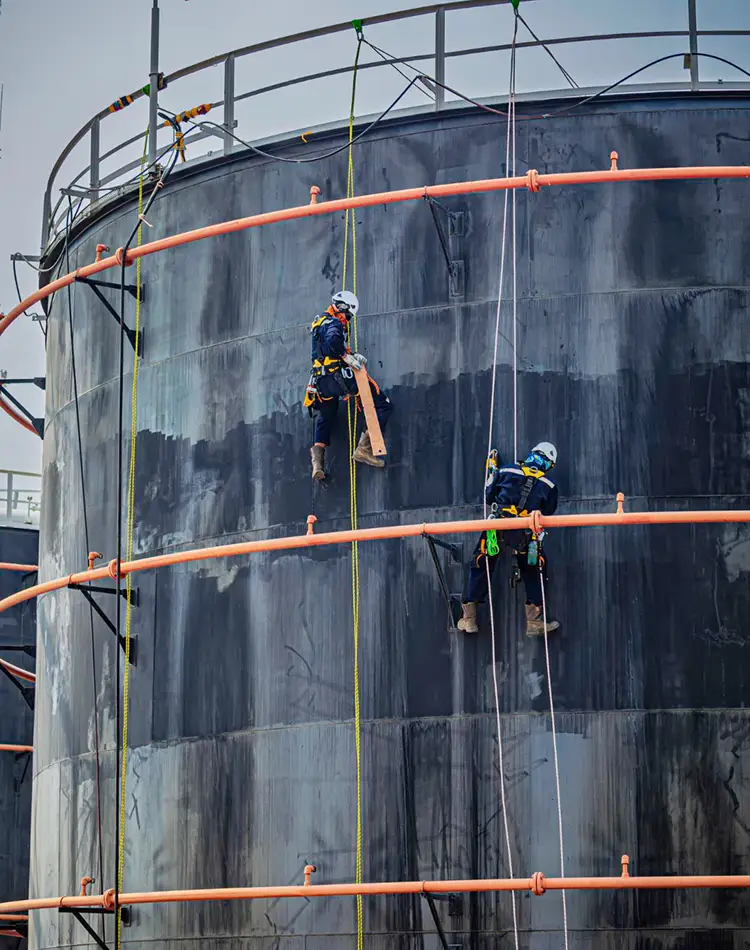
Coating and lining solve different problems. A coating sits on a surface to protect it from the environment around it. A lining is built to withstand direct, sustained contact with whatever the tank holds, whether that's product, process fluid, or chemical. Internal lining systems are chosen around what's inside the tank,
not just what the tank is made of.
Epoxy Tank Lining
Epoxy lining systems are a common choice for tanks holding fuel, chemicals, and process fluids. They offer corrosion resistance, chemical resistance, and a smooth internal surface that's easier to clean and less likely to trap contaminants. We select the specific epoxy system, and the number of coats, based on what the tank stores and how it's used.
External Tank Coating Services
External steel surfaces corrode from constant exposure to air, moisture, and temperature swings.
We coat above-ground storage tanks, buried tanks, shells, roofs, and bottoms against this exposure, with the coating system matched to the
tank type and how it operates.
Tank Types & Applications
- Crude oil and fuel storage tanks
- Water storage tanks
- Chemical storage tanks
- Above-ground and buried tanks

Tank Coating for Storage &
Process Equipment
Storage Tanks
Coating and lining for tanks storing crude oil, fuel, water, and chemicals, built around what each tank holds and how long it stays in service.
Process Vessels
Coating systems built for the chemical and process environments inside process vessels, where exposure is often more constant and more aggressive than simple storage.
Pressure Vessels
Coating built around surface protection and the coating-system requirements that come with a vessel's pressure and temperature rating, not treated as a standard tank job.
Our Tank Coating Process
Every tank is assessed on its own terms before any coating work starts. The steps below outline how a typical project runs, though the specifics, such as coating type, number of coats, and cure time,
shift depending on the tank and what it's used for.
1. Site assessment and inspection
We inspect the tank's current condition, check for existing corrosion or coating failure, and confirm what the tank stores or will store. This sets the coating spec for the rest of the job.
2. Surface preparation
Old coating, rust, and contaminants are removed through abrasive blasting, and the surface is profiled to the roughness the coating system needs to bond properly.
3. Coating and lining selection
The coating or lining system is chosen against the tank's service conditions: the product stored, temperature range, and chemical exposure it needs to withstand.
4. Application
Coating is applied by spray or manual methods depending on the tank and access, with film thickness checked against spec as each coat goes on.
5. Curing
The tank is left to cure for the time the coating system requires before the next coat or before the tank returns to service.
6. Inspection and quality control
Holiday testing, dry film thickness checks, and adhesion testing confirm the coating meets spec before the tank is signed off.
7. Handover
The tank is handed back with documentation covering what was applied, where, and to what standard, so the coating history is on record for future maintenance.
- Extends the service life of a tank instead of shortening it through unmanaged corrosion.
- Reduces the risk of tank failure, leaks, and unplanned shutdowns.
- Protects stored product from contamination.
- Cuts long-term maintenance and repair costs compared with reactive repairs after corrosion damage has already set in.
- Keeps a tank's coating system compliant with what its operating environment requires.
Our tank coating work runs under Innovations Coatings' two specialist brands: GTGC, serving Dubai and the Northern Emirates since 1971, and Posco, serving Abu Dhabi's oil, gas, and energy sector since 1995. Together, they operate from dedicated yards at Mafraq, KEZAD, and Ras Al Khor, and hold ISO 9001, ISO 14001, and ISO 45001 certification alongside ADNOC Approved Vendor status in Abu Dhabi.
Posco alone has completed over 300 projects for operators including ADNOC, NMDC, Takreer, Halliburton, Schlumberger, and Weatherford, backed by an HSE system that's built into every phase of a project rather than added on at the end.
Certifications
- ISO 9001 — Quality Management System
- ISO 14001 — Environmental Management System
- ISO 45001 — Occupational Health & Safety
- ADNOC Certified Approved Vendor, Abu Dhabi
- Dubai Government Trade & Industrial Registration; Fujairah Government Registration; Dubai Chamber Member
Planning a tank coating or lining project? Tell us the tank type, the service conditions, and what the coating needs to handle, and we'll assess it against your project.